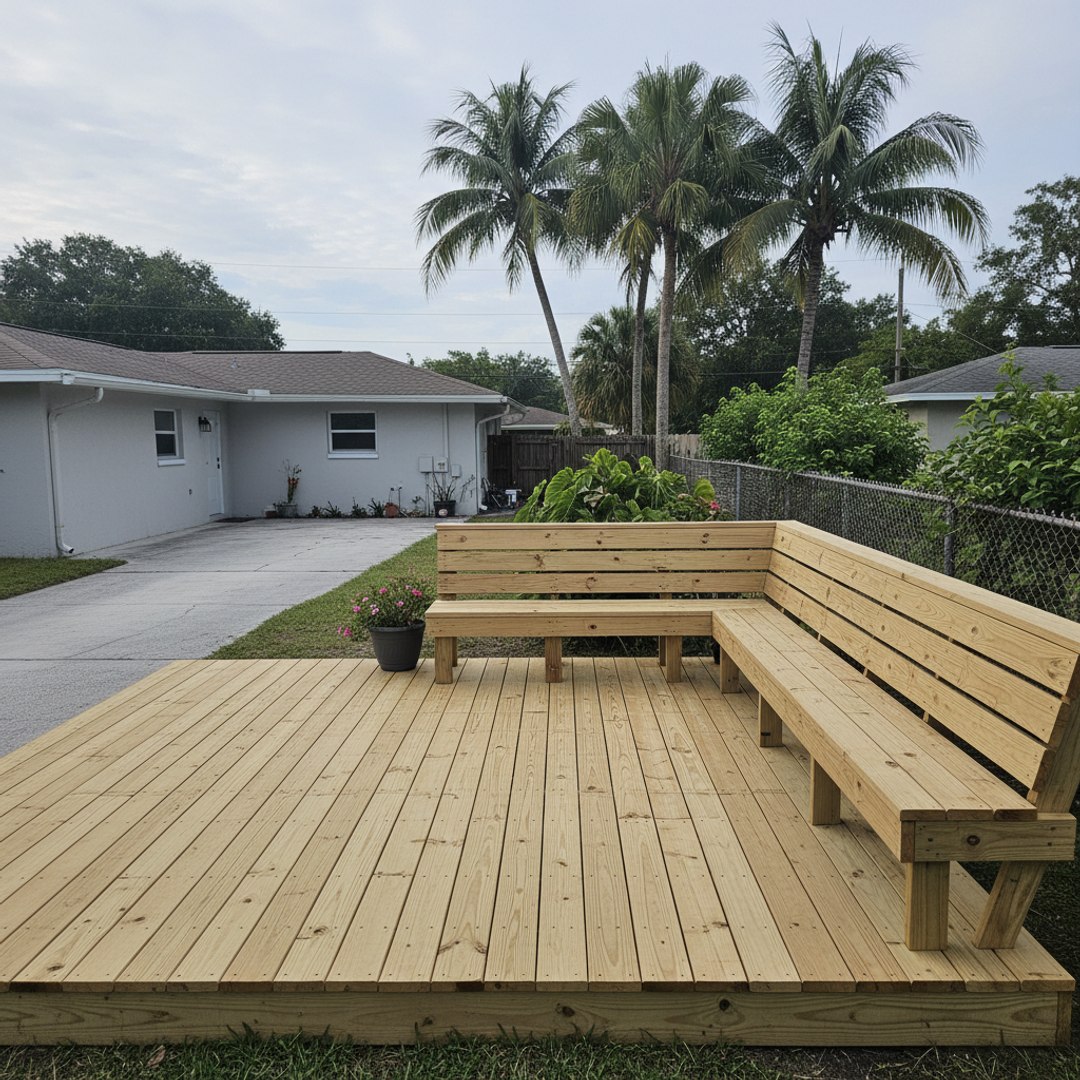
Most homeowners think about the boards. Composite or wood, gray or brown, that's the part you can picture. But the parts of a deck job that actually cause problems five years from now are underground, bolted to your house, or written into a permit file you never read. Here's what's worth ten minutes of your attention before a crew shows up with a truck full of lumber.
What's actually in the ground
Lakeland sits on sandy soil for the most part, which drains fast and is easy to dig, but a lot of lots around here were built on fill. Old citrus grove land got graded and filled decades ago, and that fill isn't always compacted the same way twice on the same property. A footing that lands on native sand holds fine. A footing that lands on a soft pocket of fill dirt can settle an inch or two over a couple of rainy seasons, and that's enough to rack a frame and crack a post base. Ask whoever's digging your footings whether they're hand-augering to bearing soil or just going to a set depth and stopping.
If you're within a few blocks of one of Lakeland's lakes, the water table can sit surprisingly close to the surface in the wet months, sometimes three to four feet down by August. That doesn't stop a deck from getting built, but it changes how deep footings can practically go and whether concrete cures the way it should before backfilling.
Sinkhole history is worth a look too
Polk County sits on karst limestone, and sinkhole activity is a real thing here, not scare talk. It doesn't mean don't build. It means if the property has a prior sinkhole claim on record, that's worth knowing before you pour footings, not after.
What's already attached to your house
If this is a new deck, most of the load runs through the ledger board bolted to your house's band board or rim joist. That connection has to be through-bolted, usually with half-inch lag bolts or carriage bolts on a set pattern, and flashed with a self-adhering membrane so water can't get behind it and rot the band board from the inside. On houses in Dixieland, Beacon Hill, or Cleveland Heights built from the 1920s through the 1950s, that band board might be solid old-growth lumber that's held up fine for eighty years. On a house from a 1990s or 2000s subdivision off South Florida Avenue or County Line Road, it's more likely OSB, and OSB that's taken on water doesn't hold a lag bolt the way solid wood does. Before anything gets attached, someone should pull back the siding or trim and actually look at what's there.
Permits, surveys, and the rules nobody reads until they're stuck
Whether your permit goes through the City of Lakeland or Polk County depends on which side of the line your lot falls on, and plenty of streets that feel like Lakeland are technically unincorporated county. Either way, a deck attached to the house almost always needs a permit, and inspectors will want to see the footing depth and ledger connection before the decking goes down, then a final once railings and stairs are in.
- If your lot backs up to one of the lakes, there's often a setback from the water's edge that a fence line doesn't tell you about. A quick look at your survey saves an argument later.
- Newer subdivisions in South Lakeland, places like Grasslands, Christina, or Highland Fairways, almost always have an HOA with deed restrictions on deck height, screening, and sometimes even the decking material itself. Older neighborhoods closer to downtown mostly don't have that layer at all.
What Florida humidity does to the materials
Pressure treated lumber is graded by chemical retention level, and it matters more here than in a drier state. Above-ground boards are usually treated to a .40 retention. Anything touching the ground, including post bases set in concrete, needs the .60 ground-contact rating or it starts breaking down years earlier than it should. It's a cheap thing to get wrong and an expensive thing to fix once the posts are buried.
Fasteners matter too. Modern ACQ-treated lumber is more corrosive to metal than the old treatment chemicals were, and standard zinc screws can start rusting and staining the wood within a couple of seasons in our humidity. Stainless steel or hot-dip galvanized fasteners cost more up front and hold up.
Subterranean termites are active in this part of Florida basically year-round, not seasonally like up north. A deck post set in untreated contact with soil, or a ledger board with a gap behind it where moisture sits, is exactly what they're looking for.
Where the water goes once it's built
Lakeland gets its rain in a real pattern, afternoon thunderstorms stacking up through June, July, and August, sometimes an inch in under an hour. A deck surface needs a slight pitch away from the house, roughly a quarter inch per foot, so that water sheds instead of pooling against the ledger. On composite decking, joist tape over the top of every joist matters more here than in a dry climate, because it's the difference between joists that last twenty years and joists that trap moisture against the wood underneath the cap.
If you're doing a screened-in porch and deck combo, that runoff question gets more complicated, since now you've got a roof line shedding water onto or near the structure too, and that usually needs its own look at gutters and grading.
None of this is meant to talk you out of building. It's meant to save you from the phone call two years in where a post is soft, a board is cupping, or a railing's gone spongy at the base. A lot of that comes down to decisions made before the first board ever got cut. If you want someone to walk your specific lot and tell you what it's actually dealing with, that's the kind of conversation New Look Deck Co has with homeowners before any contract gets signed.