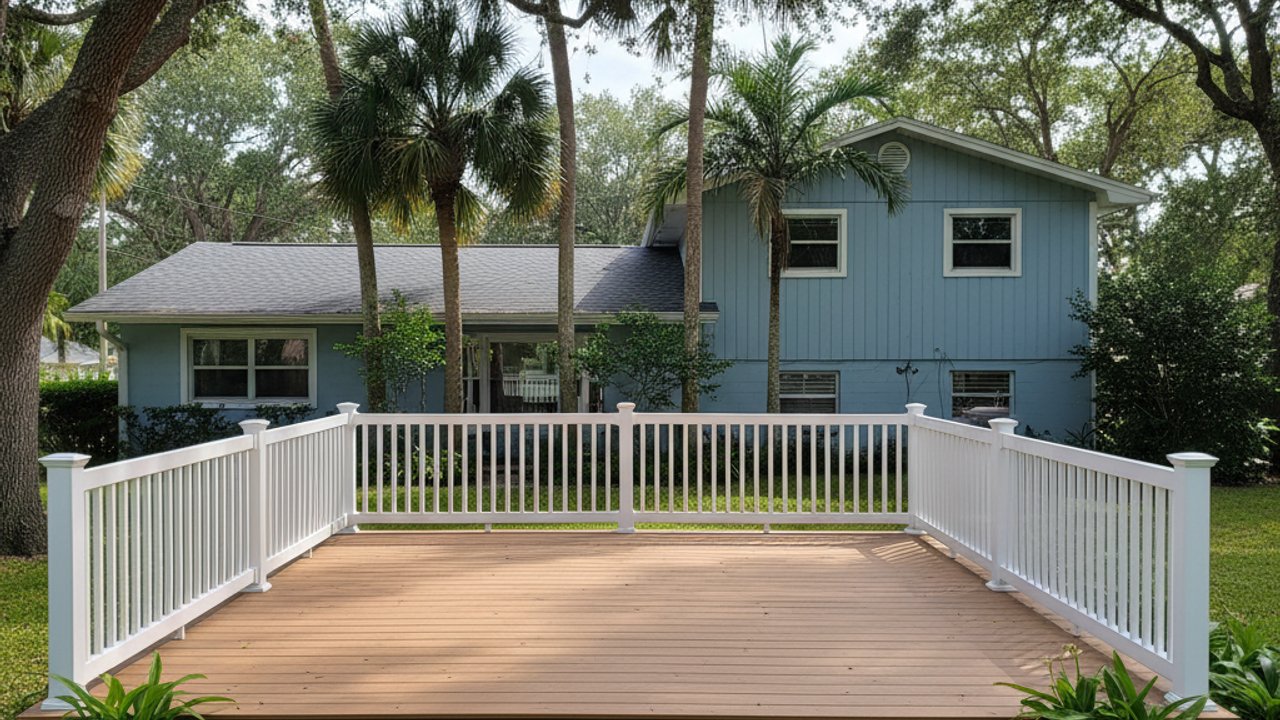
Most homeowners call around, get three numbers that are $8,000 apart, and have no idea why. Sometimes it's because one guy is planning to cut corners. More often it's because the decks being quoted aren't actually the same deck, even if they're the same square footage.
Here's what actually moves the price, and what to ask about before you sign anything.
Material is the first split, but not the only one
Pressure treated pine is still the cheapest way to build a deck in Polk County. It's what most of the framing under any deck is made from regardless of what the surface boards are, because it's strong, it's local, and it's rated for ground contact use. For the decking itself, PT pine runs cheaper than composite by a good margin, but it needs staining every 2 to 3 years and it will cup and check over time, especially on a west-facing deck that takes full Florida sun for eight hours a day.
Composite decking, the PVC or wood-plastic blend boards, costs more up front but doesn't need sealing. Boards like Trex or TimberTech come with a 25 to 50 year warranty against rot and insect damage, which matters here because Lakeland has both subterranean and drywood termites. A composite deck installed today will look close to the same in year 12. A PT pine deck that isn't restained on schedule will start silvering and splintering by year 4 or 5.
Neither choice is wrong. It depends on whether you want a lower number now or a lower number over ten years.
What's under the boards matters more than what's on top
This is the part that separates a $9,000 quote from a $16,000 quote on the same size deck, and it's the part homeowners rarely ask about.
- Footer depth: Florida doesn't have a frost line to dig below, so footers here can be shallower than what you'd see up north, typically 12 to 24 inches depending on the soil and the load. But shallow doesn't mean skipped. A footer that's too small or poured on loose fill will let a post sink an inch a year, and you won't notice until the railing starts leaning.
- Joist spacing: 16 inches on center is standard for most decking. Some composite boards allow 24 inches, some require 12. If a quote doesn't specify the spacing, ask, because a contractor spacing joists wider to save lumber is cutting into the deck's stiffness.
- Ledger board and flashing: this is where the deck attaches to the house, and it's the single most common source of failure I see on repair calls. If the ledger isn't flashed properly, water gets behind it and starts rotting the house's floor framing, not just the deck.
- Fasteners: ACQ treated lumber is corrosive to plain galvanized screws and hangers. It needs stainless steel or hot-dip galvanized hardware rated for ACQ contact. A quote using standard fasteners to save a few hundred dollars will cost you a deck that starts rusting and staining at every joint within two or three years.
Permits aren't optional and they aren't free
Lakeland and unincorporated Polk County both require a permit for a new deck attached to the house, and for most freestanding decks over 30 inches high. Permit fees typically run a few hundred dollars, and the inspection process usually means at least two inspections, one after the footers and framing are in, before any boards go down, and a final once railing and stairs are complete. A quote that doesn't include permit costs isn't necessarily hiding something, but ask directly whether it's in there or whether you'll be pulling it yourself.
Elevated decks and pool decks sometimes need an engineer's stamp on the plans, especially if the deck is more than a few feet off grade or the span is unusual. That adds cost, but it also means someone with a license is putting their name on the structure holding your family up.
Why the same deck gets three different quotes
Beyond material and framing choices, a few things quietly change the number:
Access matters. A deck on flat ground with a clear path from the driveway is faster to build than one on a slope, or one where materials have to go through a gate and across the yard by hand. Site prep, like removing an old deck, grading, or dealing with tree roots, is often quoted separately, and sometimes it's not quoted at all until the crew shows up and finds out the hard way.
Railing style changes the price a lot. Basic wood balusters are the cheapest option. Cable railing or glass panel railing can add several thousand dollars depending on the linear footage, because the hardware and tensioning alone cost more than a whole run of wood spindles.
Stairs are priced by the step, roughly, and a deck that steps down to a pool or a lower yard will cost noticeably more than one that sits level with the back door.
And labor rates genuinely vary between crews. A lower quote sometimes just means a smaller overhead, not a worse job. But if one number is dramatically lower than the other two, ask what's different in the framing spec before you assume you found a deal.
Pool decks and screened additions add their own costs
A pool deck has its own rules. Fasteners need to handle constant moisture and pool chemicals, and the framing often sits closer to grade, which means drainage and footer depth take on more importance than on a standard backyard deck. Screened-in additions add the cost of the screen framing itself, plus a door, and sometimes a rated roof structure if it's not just screening off an existing covered deck.
None of this means you need to become an expert in joist hangers before you get a quote. It means a good quote should be able to explain these choices to you without getting cagey about it. If you're comparing numbers for a project in Lakeland and want a walkthrough of what a fair build actually includes, New Look Deck Co quotes projects with the framing spec written out, not just a square footage number and a price.